
Managing the macro effects of transition risk
Institutional investors have spent a decade lowering the carbon intensity of their portfolios. This is a start, but it still leaves them exposed to macro transition risk that portfolio decarbonization cannot mitigate.
What is transition risk?
Transition risk is the risk that the economy reduces its carbon intensity faster than the assets in a portfolio were priced to expect. Most of that movement comes from government policies designed to make emitting carbon more expensive. Some do it directly, through a carbon tax or a traded allowance. Others do it indirectly, through fuel and efficiency standards, border adjustments, obligations to surrender units, subsidies for substitutes, or disclosure rules that change what lenders will finance.
The mechanism varies but the effect does not. As the cost of emitting rises, it travels through the economy and reprices assets. Emitters generate less profit per unit of revenue. Customers seek out lower-cost alternatives. Reserves and plant that were going to be used are written down, and lenders demand a higher return on carbon-intensive cash flows. On the other side of the same change, the substitutes and the businesses supplying them reprice upward.
None of this is news to a risk committee. The NGFS scenarios, MSCI Climate Value-at-Risk, the shadow carbon prices institutions set internally, and the stress tests they build themselves all rest on the same architecture: assume a path for thecarbon price, then translate it into portfolio repricing. The carbon price is the variable through which transition risk enters the portfolio.
The three layers of transition risk
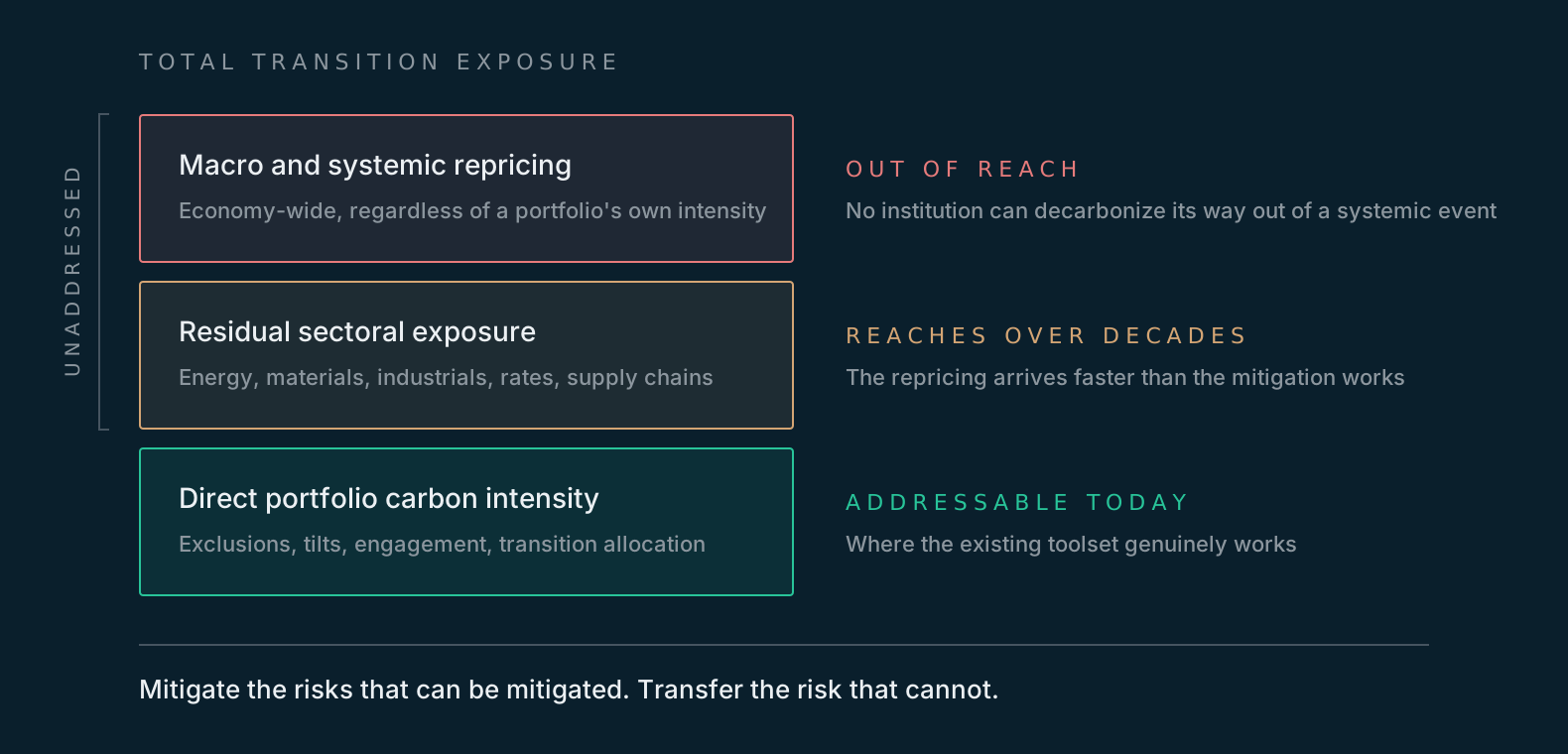
There are three layers of transition risk that affect every portfolio.
The first layer is the carbon intensity of the portfolio itself: what the institution holds and how much it emits. This is the layer an institution controls directly, through its portfolio composition.
The second layer is residual sectoral exposure, the part that survives decarbonization because a diversified mandate requires it. Energy, materials, and industrials remain in any diversified portfolio for decades, whatever the tilt, and exposure to them extends beyond direct holdings into credit, rates, and supply chains. Decarbonizing at that depth is measured in decades; a repricing can arrive inside a single budget cycle. Mitigation through portfolio decarbonization therefore cannot move fast enough to manage this second layer.
The third layer is macroeconomic transition risk. When a major economy tightens carbon policy at scale, the effect is not confined to its own emitters, or to its own borders. Input costs rise, growth slows, inflation and interest rates move, and sovereign bonds, real estate, and currencies reprice with them. The effect crosses borders through trade and commodity prices, and through capital markets. In the EU's case the border adjustment mechanism now charges the EU carbon price on covered imports directly. If the EU or China tightens at scale, no open economy escapes the effect, whatever the tightness or looseness of its own domestic policy, and even a portfolio holding nothing but government debt and a broad equity index would feel it. This layer is a property of the world economy rather than of any holding. There is nothing in the portfolio to sell that would make it go away, and no institution can decarbonize its way out of a systemic event.
We started with what we could directly affect: portfolio composition
The first layer is the natural place to start, because it is the one an institution controls, and decarbonization is direct mitigation. Institutions have implemented it through a number of techniques. Exclusion removes the heaviest emitters. Tilting keeps a sector but overweights the cleaner companies within it. Engagement uses ownership to push companies onto their own transition plans. Allocation to renewables, grid, and storage moves capital toward the businesses expected to benefit from the energy transition. Each lowers the carbon intensity of the portfolio, and with it the portfolio's sensitivity to the carbon price. Many large investors now report portfolio carbon intensities well below where they stood a few years ago.
Portfolio decarbonization addresses the first layer and does not reach the other two. What remains must be managed in one of two ways, borne internally or transferred to a third party. Today it is almost entirely borne. Macro transition risk sits in institutional portfolios as a naked exposure, no different from an unhedged interest rate position: a small move is noise, and a large one is a loss taken in full, across the whole portfolio, at once.
Mitigation and transfer are different jobs
Mitigation reduces a risk by repositioning the portfolio away from it. Transfer offsets a risk by holding something whose value moves the other way when the risk materializes. An insurer writes property insurance on coastal homes and transfers the hurricane risk it cannot avoid to a reinsurer. A pension fund with long-dated liabilities enters interest rate swaps so that a move in rates that hurts one side of its balance sheet is offset on the other. Those swaps sit in the largest derivatives market in the world, interest rate derivatives, at roughly $670 trillion in notional value outstanding at mid-2025 according to the Bank for International Settlements. Sophisticated institutions do not choose between the two. Mitigation and transfer are used in combination, and that combination is established market practice for every material market risk they carry except this one.
Transferring transition risk means taking a position in carbon
Effectively transferring transition risk requires a position whose value increases as transition risk increases: an asset that rises when the carbon price rises, so that its gain offsets the repricing the same policy step inflicts elsewhere in the portfolio. That is the ordinary specification for a hedge. The asset is affected by the same event as the portfolio, in the opposite direction and in proportionate magnitude.
Carbon is that asset, and here is what separates carbon from every proxy. A proxy rests on a correlation observed in the data, and observed correlations break. Carbon's relationship to transition risk is different in kind. The policies that constitute transition risk, such as a tighter emissions cap, a higher carbon tax, or a new obligation to surrender carbon units, are designed and explicitly intended to raise the carbon price.
Carbon is the very thing the policy prices, so its value tracks the cost of emitting by construction rather than by coincidence. Tightening the policy causes portfolios to reprice down while carbon reprices up, as two effects of one decision, with no third variable intermediating the effect. That structural link between the asset's price and transition policy is what makes it possible to transfer the risk, and it is why the carbon price is already the variable inside the institution's own models. The risk factor and the hedge are the same thing.
What remains is a question of form
The macro layer of transition risk cannot be mitigated, and it cannot responsibly be ignored. What the market needs is a financial mechanism for transferring it: a form of carbon that an institution can hold as a position, at scale and across jurisdictions, rather than consume as an offset, which is the only purpose carbon credits have been packaged for. That form now exists. AeonLoop has designed a family of structures that allow an institution to establish and hold a position in carbon for financial purposes, and advises governments and institutions on deploying them.
A carbon position completes the toolset. Mitigate the risks that can be mitigated. Transfer the risk that cannot.